


• Archives

  • Categories

  • Named one of the top Atheist / Agnostic Blogs by Unreasonable Faith
  • Recent Comments

    nancyabramsblogger's avatarnancyabramsblogger on World Blasphemy Day
    peterohara's avatarpeterohara on Respect for persons; no respec…
    Shane's avatarShane on Respect for persons; no respec…
    Laura's avatarLaura on Constitutional Convention Dead…
    peterohara's avatarpeterohara on HAI’s EGM on 26 June 201…
  • Meta

  • Wikipedia Affiliate Button

Constitution of Ireland, if Article 41.2 removed, will still show duty of parents in Articles 42 and 42A

The Dáil and Senate have on 23 January 2024 passed 2 Bills for 2 Referenda to make 2 changes to Article 41 of the Constitution of Ireland.

Voting Day for the 2 Referenda will be Friday 08 March 2024.

Each voter will receive 2 Ballot Papers, one for each Amendment/ Referendum.

To help people to decide how they will vote, the Mid-West Humanists will hold an Open Meeting on Tuesday 20 February 2024.

One Referendum, for Amendment no 40, will remove Article 41.2, if a majority of the people vote Yes. Part of this Amendment will thus remove reference to a mother’s … duties in the home.

Some voters are concerned that this duty will then be entirely absent from the Constitution.

This is probably not true: the duty exists in some other Articles of the Constitution.

To help with people’s decisions, we show here the text of Articles 42 and 42A. These will remain the same after one Referendum or both is/ are passed by the people.

We show here how Article 42 (Education) and Article 42A (Children) say that the State respects the duty of parents to provide for the education of their children (42), and respects the duty of parents, generally (42A).
We here emphasise in blue the words that show these duties.

The duty of parents in Article 42 is that they provide for the education of their children. They may do this by sending their children to a school, but the parents still do other education generally at home, that does not happen in schools.

The duty of parents in Article 42A is not specified; but in section 2 of Article 42A their failure to do that duty may involve the State supplying the place of the parents. This permits the law that a Court (a Judge) can take a child, whom the parents have so failed, away from those parents.
Thus the duty of parents in section 2 of Article 42A is to give all the care and support that is normal for parents to give. This is wider than a mother’s … duties in the home. It includes the same duty of fathers, and the duty of both parents when the child(ren) are neither at home or at school.


ARTICLE 42                          Education

1 The State acknowledges that the primary and natural educator of the child is the Family and guarantees to respect the inalienable right and duty of parents to provide, according to their means, for the religious and moral, intellectual, physical and social education of their children.

2 Parents shall be free to provide this education in their homes or in private schools or in schools recognised or established by the State.

3        1° The State shall not oblige parents in violation of their conscience and lawful preference to send their children to schools established by the State, or to any particular type of school designated by the State.

2° The State shall, however, as guardian of the common good, require in view of actual conditions that the children receive a certain minimum education, moral, intellectual and social.

4 The State shall provide for free primary education and shall endeavour to supplement and give reasonable aid to private and corporate educational initiative, and, when the public good requires it, provide other educational facilities or institutions with due regard, however, for the rights of parents, especially in the matter of religious and moral formation.


ARTICLE 42A                       Children                (inserted by a Referendum in 2012)

1       The State recognises and affirms the natural and imprescriptible rights of all children and shall, as far as practicable, by its laws respect and vindicate those rights.

2       1° In exceptional cases, where the parents, regardless of their marital status, fail in their duty towards their children to such extent that the safety or welfare of any of their children is likely to be prejudicially affected, the State as guardian of the common good shall, by proportionate means as provided by law, endeavour to supply the place of the parents, but always with due regard for the natural and imprescriptible rights of the child.

2° Provision shall be made by law for the adoption of any child where the parents have failed for such a period of time as may be prescribed by law in their duty towards the child and where the best interests of the child so require.

3       Provision shall be made by law for the voluntary placement for adoption and the adoption of any child.

4     1° Provision shall be made by law that in the resolution of all proceedings—

i      brought by the State, as guardian of the common good, for the purpose of preventing the safety and welfare of any child from being prejudicially affected, or

ii      concerning the adoption, guardianship or custody of, or access to, any child,

the best interests of the child shall be the paramount consideration.

2° Provision shall be made by law for securing, as far as practicable, that in all proceedings referred to in subsection 1° of this section in respect of any child who is capable of forming his or her own views, the views of the child shall be ascertained and given due weight having regard to the age and maturity of the child.

We hope that people’s knowledge of these Articles will help people when deciding how to vote.

We have 3 further posts relevant to deciding how to vote.

  1.  You can read about the Open Meeting, on Tuesday 20 February 2024, about the Amendments and the Referenda.
  2. We show a list of changes that a voter might have wanted, though most of these are not included in the 2 Referenda. You could read this list to see if you can be clearer in your own mind what changes you wanted. You could compare your idea to what is included in the 2 Referenda. That may help you decide which way to vote.
  3.  We show the present words of Article 41, together with the words as they will be if each Amendment is passed, and if both Amendments are passed.


Text of Constitution of Ireland 2024, Article 41, now and when or if amended

The Dáil and Senate on 23 January 2024 passed 2 Bills for 2 Referenda to make 2 changes to Article 41 of the Constitution of Ireland.

The day to Vote on the 2 Referenda will be Friday 08 March 2024.

Each voter will receive 2 Ballot Papers, one for each Amendment/ Referendum.


To help people to decide how they will vote, the Mid-West Humanists will hold an Open Meeting on Tuesday 20 February 2024.

To help with people’s decisions, we show here the text of Article 41 as it is now.

After that, we show the text of Article 41 as it will be –

if Amendment no 39 is passed by the people;
if Amendment no 40 is passed by the people;
if both Amendments nos 39 and 40 are passed by the people.


Article 41, as it is now

1.      1° The State recognises the Family as the natural primary and fundamental unit group of Society, and as a moral institution possessing inalienable and imprescriptible rights, antecedent and superior to all positive law.

2° The State, therefore, guarantees to protect the Family in its constitution and authority, as the necessary basis of social order and as indispensable to the welfare of the Nation and the State.

2.      1° In particular, the State recognises that by her life within the home, woman gives to the State a support without which the common good cannot be achieved.

2° The State shall, therefore, endeavour to ensure that mothers shall not be obliged by economic necessity to engage in labour to the neglect of their duties in the home.

3.      1° The State pledges itself to guard with special care the institution of Marriage, on which the Family is founded, and to protect it against attack.

2° A Court designated by law may grant a dissolution of marriage where, but only where, it is satisfied that –
i      there is no reasonable prospect of a reconciliation between the spouses,
ii      such provision as the Court considers proper having regard to the circumstances exists or will be made for the spouses, any children of either or both of them and any other person prescribed by law, and
iii      any further conditions prescribed by law are complied with.

3° Provision may be made by law for the recognition under the law of the State of a dissolution of marriage granted under the civil law of another state.

4.     Marriage may be contracted in accordance with law by two persons without distinction as to their sex.

————————————————-

In the versions of Article 41 that are possible after being amended,

bold indicates words that will be added;
strikethrough indicates words that will be removed.
plain text indicates words that will remain the same

Article 41, as it will be if Amendment no 39 is passed

1.      1° The State recognises the Family, whether founded on marriage or on other durable relationships, as the natural primary and fundamental unit group of Society, and as a moral institution possessing inalienable and imprescriptible rights, antecedent and superior to all positive law.

2° The State, therefore, guarantees to protect the Family in its constitution and authority, as the necessary basis of social order and as indispensable to the welfare of the Nation and the State.

2.      1° In particular, the State recognises that by her life within the home, woman gives to the State a support without which the common good cannot be achieved.

2° The State shall, therefore, endeavour to ensure that mothers shall not be obliged by economic necessity to engage in labour to the neglect of their duties in the home.

3.      1° The State pledges itself to guard with special care the institution of Marriage, on which the Family is founded, and to protect it against attack.

2° A Court designated by law may grant a dissolution of marriage where, but only where, it is satisfied that –
i      there is no reasonable prospect of a reconciliation between the spouses,
ii      such provision as the Court considers proper having regard to the circumstances exists or will be made for the spouses, any children of either or both of them and any other person prescribed by law, and
iii      any further conditions prescribed by law are complied with.

3° Provision may be made by law for the recognition under the law of the State of a dissolution of marriage granted under the civil law of another state.

4.     Marriage may be contracted in accordance with law by two persons without distinction as to their sex.

————————————————-

Article 41, as it will be if Amendment no 40 is passed

1.      1° The State recognises the Family as the natural primary and fundamental unit group of Society, and as a moral institution possessing inalienable and imprescriptible rights, antecedent and superior to all positive law.

2° The State, therefore, guarantees to protect the Family in its constitution and authority, as the necessary basis of social order and as indispensable to the welfare of the Nation and the State.

2.      1° In particular, the State recognises that by her life within the home, woman gives to the State a support without which the common good cannot be achieved.

         2° The State shall, therefore, endeavour to ensure that mothers shall not be obliged by economic necessity to engage in labour to the neglect of their duties in the home.

As Amendment no 40 deletes all of Section 2, it reduces the number of each later section by 1

2.      1° The State pledges itself to guard with special care the institution of Marriage, on which the Family is founded, and to protect it against attack.

2° A Court designated by law may grant a dissolution of marriage where, but only where, it is satisfied that –
i      there is no reasonable prospect of a reconciliation between the spouses,
ii      such provision as the Court considers proper having regard to the circumstances exists or will be made for the spouses, any children of either or both of them and any other person prescribed by law, and
iii      any further conditions prescribed by law are complied with.

3° Provision may be made by law for the recognition under the law of the State of a dissolution of marriage granted under the civil law of another state.

3.     Marriage may be contracted in accordance with law by two persons without distinction as to their sex.

Amendment no 40 inserts a new Article, with the title “Care”

ARTICLE 42B               Care

The State recognises that the provision of care, by members of a family to one another by reason of the bonds that exist among them, gives to Society a support without which the common good cannot be achieved, and shall strive to support such provision.


————————————————-

Article 41, as it will be if Amendment nos 39 and 40 are passed

1.      1° The State recognises the Family, whether founded on marriage or on other durable relationships, as the natural primary and fundamental unit group of Society, and as a moral institution possessing inalienable and imprescriptible rights, antecedent and superior to all positive law.

2° The State, therefore, guarantees to protect the Family in its constitution and authority, as the necessary basis of social order and as indispensable to the welfare of the Nation and the State.

2.      1° In particular, the State recognises that by her life within the home, woman gives to the State a support without which the common good cannot be achieved.

         2° The State shall, therefore, endeavour to ensure that mothers shall not be obliged by economic necessity to engage in labour to the neglect of their duties in the home.

As Amendment no 40 deletes all of Section 2, it reduces the number of each later section by 1

2.      1° The State pledges itself to guard with special care the institution of Marriage, on which the Family is founded, and to protect it against attack.

2° A Court designated by law may grant a dissolution of marriage where, but only where, it is satisfied that –
i      there is no reasonable prospect of a reconciliation between the spouses,
ii      such provision as the Court considers proper having regard to the circumstances exists or will be made for the spouses, any children of either or both of them and any other person prescribed by law, and
iii      any further conditions prescribed by law are complied with.

3° Provision may be made by law for the recognition under the law of the State of a dissolution of marriage granted under the civil law of another state.

3.     Marriage may be contracted in accordance with law by two persons without distinction as to their sex.

Amendment no 40 inserts a new Article, with the title “Care”

ARTICLE 42B               Care

The State recognises that the provision of care, by members of a family to one another by reason of the bonds that exist among them, gives to Society a support without which the common good cannot be achieved, and shall strive to support such provision.


In the versions of Article 41 that are possible after being amended as above,

bold indicates words that will be added;
strikethrough indicates words that will be removed.
plain text indicates words that will remain the same.

We have 3 further posts relevant to deciding how to vote.

  1.  You can read about the Open Meeting, on Tuesday 20 February 2024, about the Amendments and the Referenda.
  2. We show a list of changes that a voter might have wanted, though most of these are not included in the 2 Referenda. You could read this list to see if you can be clearer in your own mind what changes you wanted. You could compare your idea to what is included in the 2 Referenda. That may help you decide which way to vote.
  3. We show the words of Articles 42 and 42A, because they contain State support for duties of parents that will remain in the Constitution if a majority of the people vote Yes to Amendment no 40. Here are 3 reasons to read these Articles –
    1. Article 42 supports the duty of parents to provide Education to their children.
    2. Article 42A supports the duty of parents to provide all aspects of care to their children.
    3. Both Articles 42 and 42A refer to parents, that is, both mothers and fathers (non-sexist).


Mid-West Humanists to hold Open Meeting on the Referenda on Article 41


The Voting Day for the Referenda will be Friday 08 March 2024.

The Mid-West Humanists will hold a meeting, about the 2 Referenda about Article 41 of the Constitution.

Any person can attend. A person can speak their views, hear others’ views, and discuss this matter.

We hope that by the end of the meeting people will know better how they will vote.

The meeting will be –

Date                      :             Tuesday 20 February 2024

Time                     :             20:00

Venue                   :             Strand Hotel, Ennis Road, Limerick 

The meeting is in a room on the 6th floor. There is a lift from Reception; there is a lift from the car park to Reception.

The meeting is open, and all people are welcome.

Make sure that you are registered to vote in the Referenda which will be on Friday 08 March 2024.

Purpose of the Meeting

This meeting is an opportunity for all persons interested in the Constitution of Ireland, and in improving or modernising the Constitution – an opportunity to consider carefully which way to vote in the coming 2 Referenda about Article 41.

We can only vote Yes or No to what the Dáil and Senate send to us. It looks likely that many of the people who want to change Article 41 want to change it more extensively or profoundly than that.
The meeting is to help you decide whether to vote Yes or No when the proposals are not how you would write them.

The Citizens’ Assembly on Gender Equality recommended in 2021 that the Constitution –

  1. continue to recognise the Family, and protect private and family life, including forms of family life beyond the Family based on marriage; and that
  2. the text of Article 41.2 (woman, mothers’ duty, in the home) be replaced by language that is not gender specific and recognises the principle of valuing and sharing care and commits the State to ensuring that its policies reflect this principle.

In January 2024 the Dáil and Senate passed 2 Bills to amend Article 41 of the Constitution. The Oireachtas (Dáil and Senate) now send them to the people in 2 Referenda, for the people’s vote, Yes or No.
Amendment no 39 is about the Family – item 1 by the Citizens’ Assembly

Amendment no 40 is about woman in the home – item 2 by the Citizens’ Assembly

The Bills propose changes that are less than what the Citizens’ Assembly on Gender Equality recommended. We the people cannot enlarge the changes to what the Citizens’ Assembly sought; we can only vote Yes or No to what the Dáil and Senate send to us.

Conduct of the Meeting

This meeting will try to allow every person, who so desires, to give their opinion. While one person is giving their view, we ask all others to listen, and not to talk.

Any person can have a view on what another person has said. We want to hear these opinions also – if you have such a view, please wait until the other person has finished speaking and until the chairperson has indicated that it is your turn to speak.

We hope that both speaking your own opinion out loud and hearing other opinions will make things clearer in your mind as to the best way for you to vote.

You may also ask questions of any person and of us who are running the meeting. Please answer as best you can if someone asks a question of you – though you are not obliged to answer.

At the end of the meeting, the good result will be that as many people as possible will know how they will vote, for their own reasons.


We have 3 further posts relevant to deciding how to vote.

  1.  We show the present words of Article 41, together with the words as they will be if each Amendment is passed, and if both Amendments are passed.
  2. We show a list of changes that a voter might have wanted, though most of these are not included in the 2 Referenda. You could read this list to see if you can be clearer in your own mind what changes you wanted. You could compare your idea to what is included in the 2 Referenda. That may help you decide which way to vote.
  3. We show the words of Articles 42 and 42A, because they contain State support for duties of parents that will remain in the Constitution if a majority of the people vote Yes to Amendment no 40. Here are 3 reasons to read these Articles –
    1. Article 42 supports the duty of parents to provide Education to their children.
    2. Article 42A supports the duty of parents to provide all aspects of care to their children.
    3. Both Articles 42 and 42A refer to parents, that is, both mothers and fathers (non-sexist).

Census 2022: if you are not religious, mark “No Religion”

The Census of all the people in the Republic of Ireland is to be on Sunday 03 April 2022.

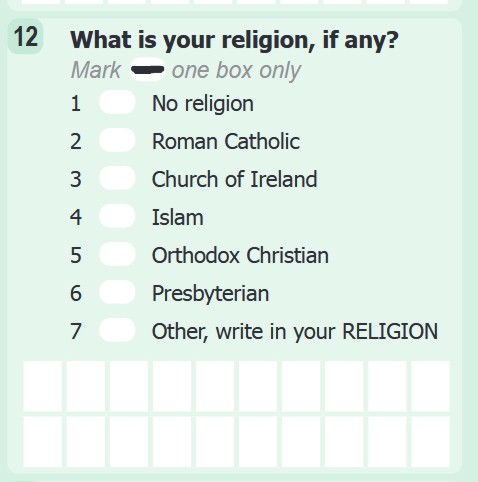
Question 12 is about the religion of each person.

The Mid-West Humanists, with the Humanist Association of Ireland, and with Atheist Ireland, ask all people who do not practise any religion to choose the option “No Religion” when replying to Question 12.

Here is a copy of Question 12, in the Census of 2022.

The Central Statistics Office have improved the question from the version of several past Censuses, to some degree. It is now more probable that a person who has no religion will choose the appropriate answer, because “No Religion” is now the first option.

For your information, we show the 2016 version of Question 12 at the end of this article, with our view why the 2022 version has improved Q12 somewhat, and how it should be improved further.

Why it is important to answer Question 12, Religion

Our Government uses information about the people, from the Census and from other sources, to help to plan how government services are distributed and administered – health, education, justice, social services, and others.

If the number of people said to have “No Religion” in the Census is close to the actual number in Ireland, the Census will have done the maximum to have Government services changed so as to be good and fair to people with no religion, as well as to people of all the various religions.

Some important errors to avoid at Question 12

The partly improved 2022 version of Question 12 most probably will lead to a larger proportion of people being marked as having no religion, even if the actual proportion has not increased. (The actual proportion surely has increased: Ireland has in fact become more secular than it was in 2016). Yet people could still make some mistakes.

In Question 12 in the Census of 2016, the open box where a person can write the name of their religion (“Other”), was before “No Religion”. Some people wrote “Atheist”, “Humanist”, “Jedi”, and some other words that are fairly surely not religions. At least those who wrote “Atheist” and “Humanist” had no religion, but they were not included in the number of people with no religion that the Central Statistics Office announced (the results of the Census).

We do not know if some of those who wrote “Jedi” and similar words had no religion, or if they were making a joke.

To maximize the number of people that the Census will say have no religion, that is, to report the number truly – if you are not religious, do not write in the box for “Other” religions. Mark the box “No Religion” when replying to Question 12.

If another person in the household is completing the Census form

An official person delivers the Census form and collects it after the Census day. This person is called the Census enumerator. The enumerator arranges one person per household to fill in the form. This person is then called Person No 1.

If you are not Person No 1, that person might enter some or all of the information about you without asking you, or incorrectly. We believe that some persons who were Person No 1 in past Censuses wrote the religion that he or she thought was the religion of other persons in the household, when that was not the other person’s true religion (or irreligion).

If you are not sure that Person No 1 will respond to Question 12 as you desire, you can ask the enumerator for a Census form for you alone. This is your right in any case, if you want to keep matters private, and you do not have to prove to the enumerator that the Person No 1 will record your details incorrectly.

Why it is important to mark “No Religion”

Many of our Government’s services have been and still are administered with a bias towards religion, with a bias towards all the people who live in Ireland having some religion, and in many instances with a bias as if nearly all the people belong to the Roman Catholic Christian religion.

The Mid-West Humanists have since 2013 campaigned to various branches of our Government to abandon these biases in particular aspects of the Constitution, laws, and methods of administering services. It has been quite difficult to convince TDs and Senators, and to convince the Constitutional Convention (2013), whom we met, that there is any need to make the Constitution, laws, and services secular.

Ministers and TDs are a lot more open to adapting how the Government serves the people, to fit with people of new religions (that is, religions that are only starting to have many adherents in Ireland), than they are to fit with people with no religion. In the Census of 2016, there were 468,400 persons (just under 10 percent of the population) recorded as having no religion, and this was greater than the number recorded with all the religions, other than Roman Catholic, together. Yet adaptations to the religions that are newer to Ireland seem to interest our Government more.

The Mid-West Humanists, with the Humanist Association of Ireland, and with Atheist Ireland, ask all people who do not practise any religion to choose the option “No Religion” when replying to Question 12.

Question 12 in the past, how it was faulty, and how to improve it fully

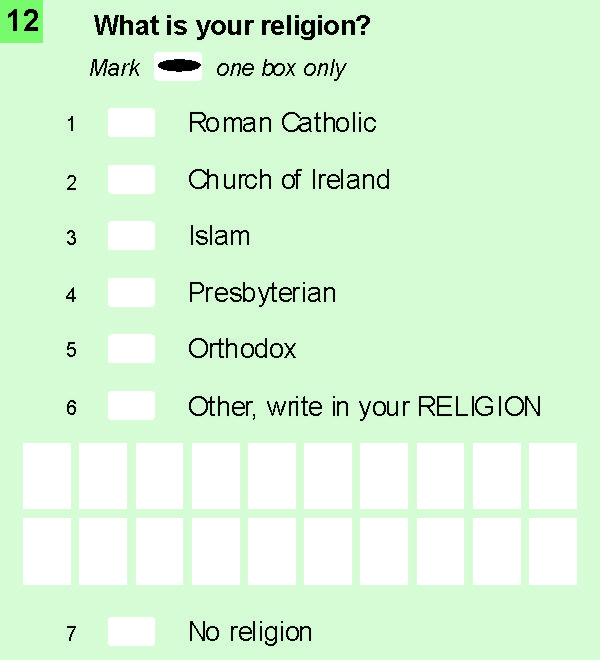
Here is a copy of Question 12, in the Census of 2016.

Census IRL 2016 Q12 Religion

The question is “What is your religion?” This biases a person away from considering if he or she has no religion. The new question in 2022 allows that a person may not have any religion, but it still has a bias that to have a religion is the normal or usual (default) state of a person.

The option “No Religion” was the last option in 2016. People who are asked to pick one of several printed options give some attention to the first option, and they consider whether it is correct, and then a smaller amount of attention to the next option, attention reducing further as the person scans down the list. Often a person becomes tired of reading the options. This leads to a bias towards options nearer the start of the list.

We are fairly sure that, in all the years up to and including 2016, this led to people who were not really religious choosing one of the religions at the top of the list. The name of the religion may have reminded people of the religion of their childhood, and the person now had an option which they could mark, before the person saw that “No Religion” was available at the end of the list.

Accordingly, the Mid-West Humanists, as Atheist Ireland and the Humanist Association of Ireland, are fairly sure indeed that the number of people who chose “No Religion” in the Census of 2016, as well as in several previous Censuses, was substantially less than the true number of people with no religion.

While the version of the Religion question in the Census of 2022 is better than that in 2016, the sensible version would split it into 2 questions –
Q12a – Do you practise a religion? No [ ] Yes [ ]
If you answered Yes to Q12a-
Q12b – What is your religion? – Write the name of the religion here [ ]

Mid-West Humanists ask Dáil Candidates for Secular Declarations and for Secular Schools

The General Election is on Saturday 2020 February 08.

We have campaigned in the past decade about secular declarations for President, judges, and the Council of State; to remove references to god from the Constitution; and for secular State funded schools. In 2018 we were on the street in Limerick to give reasons to vote Yes in the then Referendum which removed Blasphemy from the Constitution by votes in a ratio of 4 to 1.

The Mid-West Humanists are sending the following request to all Candidates who seek election to Dáil Éireann in Limerick, Clare, and Tipperary.


To a Candidate who seeks election to Dáil Éireann 2020

The referenda of 2015 (same sex marriage, 63% Yes), 2018 (abortion legal, 62% Yes), and 2018 (blasphemy offence gone, 81% Yes) showed that people in Ireland want less influence of religion on society and the State.

Other influences remain, and so we ask –

1- That you support changing the Constitution to have a single secular Declaration for judges, the President, and the Council of State, and to require this in all State declarations (in court, in polling stations).

2- That you support Bills and regulations to ensure all our state funded schools have equality, inclusion and fairness in the following –

(a) Admission with no discrimination by religion
(b) To teach all children about many religions and about no religion, within normal school time; and classes to teach belief in a religion outside normal school hours
(c) End discrimination by religion in employment of teachers
(d) No religious icons in view in schools

—————-END—————–


How the Dáil and Government can make the changes, and why

  1. The Constitution and legal Declarations.
    The Bill to amend the Constitution will remove the phrase “in the presence of Almighty God” and the sentence “May God direct and sustain me” from the declarations on starting public office from 3 Articles of the Constitution.

At present, a Judge (article 34.6.1) must promise to do the job faithfully “in the presence of Almighty God”. Some judges have no religion, or their religion has no single almighty god, and thus on the first day of work they are forced to lie. We need honest judges. And we need to NOT know their religion or lack of religion, so as to avoid thinking a judge is biased. So there should be only ONE declaration.

The President (article 12.8) must also mention God, in the same words.
Members of the Council of State (article 31.4) also must mention God, by the first phrase only. At least one member of the Council (then Tánaiste Éamon Gilmore) was thus forced to lie in 2013.

The same Bill could insert a rule that all legal declarations that the State demands must be secular.


  1. State Funded Schools – that receive public money.
    The Bills will be to amend the Education Act 1998, the Equal Status Act 2000, and the Employment Equality Act 1998.
    The system of National Schools, and the Lease of each National School, gives power to the Minister for Education to make rules for National Schools. Part of achieving (a), (b), (c), and (d) in Primary (National) schools will be by the Minister changing the rules.

The Constitution requires these changes – it directs that schools be secular –

Article 44.2.4 of the Constitution notes that every child has a right “to attend a school receiving public money”, and also that same right “without attending religious instruction at that school”.
Article 42.3.2 of the Constitution sets the State a duty that “children receive a certain minimum education, moral, intellectual, and social”. Social education means coming to understand the people among whom you live. This includes learning about the variety of ideas and beliefs of your fellow students and of adults. So every child at school should meet and understand all of the children that live in their society – together, not segregated.


Further information –

email: info@midwesthumanists.com

We have a leaflet of this post which you can download and print to give directly to a candidate.

Our Media page has this and other leaflets on Education and on a secular Constitution.

Referendum 24 May 2019: remove 4 years apart limit for Divorce from Article 41 of the Constitution

Vote YES so you don’t have to live 4 of the last 5 years apart to qualify for a divorce
and to let the Dáil and Senate legislate on foreign divorces

The Mid-West Humanists have favoured a Secular society and laws that uphold Human Rights from soon after we first met in 2008.

We have campaigned, and attended the Constitutional Convention in 2013, on other parts of the Constitution that have explicit biases towards religion and biases against people with no religion and people whose religions have fewer adherents. We and other non-religious organisations have secured the 2018 referendum to remove Blasphemy as an offence from Article 40 of Ireland’s constitution. We were the only set of people campaigning in public in the Mid-West region for people to vote Yes in October 2018.

The Mid-West Humanists now draw people’s attention to removing the minimum time apart to qualify for a divorce and to removing the restriction on the Oireachtas’ choice in recognising foreign divorces.


The Referendum is on Friday 24 May 2019!

The 38th Amendment to the Constitution (Dissolution of Marriage) Bill 2019 proposes to remove Article 41.3.2.i.
This subordinate clause of 34 words sets a minimum of 4 years living apart (in the last 5 years) before you can be divorced.
If a majority vote YES, the Constitution will no longer set a minimum time. The Minister for Justice has said he will set a minimum of 2 years apart in a new Bill in the Dáil and Senate.

Although you may think the 2 years apart is still an unreasonable requirement, it will only be in legislation. A vote in the Dáil and Senate could reduce or abolish it at any future time. But it will not need a referendum.

The 38th Amendment to the Constitution (Dissolution of Marriage) Bill 2019 also proposes to replace Article 41.3.3.
This sentence of 65 words sets a high bar to the recognition of a foreign divorce here in Ireland – perhaps its precise limitation is not clear.
If a majority vote YES, the Constitution will no longer set any rules on recognition. Such recognition would be by a Bill in the Dáil and Senate.

The Mid-West Humanists support every person who favours a secular society and state, and who favours freedom of association (to be able to more easily end your tie to a person to whom you have been married), to vote YES in the Referendum on Friday 24 May 2019.
It is on the same day as the election for City and County Councils and for the European Parliament.

We ask any person who thinks it almost sure to receive a majority YES to make sure that you yourself vote. If a large number who favour removing the 4 years that you must be apart do not cast their vote, the majority could be a NO. Please go to the polling station on 24 May 2019 and vote YES.

If you want the referendum to pass, it needs your vote as well as all the other YES votes.


Go to vote on Friday 24 May and vote YES!

Referendum 26 October 2018: remove “blasphemous” from Article 40 of the Constitution

Vote YES to remove the offence of blasphemy

Our leaflet contains the main reasons to vote YES. These reasons apply whether you have a religion or have no religion.
You can download or print the leaflet if you wish.

The Mid-West Humanists have campaigned against blasphemy laws from soon after we first met in 2008.

We wrote to the President and talked to the Limerick Post in 2009 as the Defamation Act 2009 was about to become law, whose Section 36 explains what amounts to the offence of blasphemy.

We wrote to and attended the Constitutional Convention in 2013 to say that the State’s obligation to have Blasphemy be an offence should be removed from Article 40 of Ireland’s constitution. Some of us went to most TDs in our region to ask that the Dáil and Senate vote for a bill to remove it, if the Convention so recommended.

After the murders in January 2015 of 10 of the staff of Charlie Hebdo magazine in Paris, by people who were Muslim, because Charlie Hebdo had published many cartoons that satirised Mohammed, we went on the street in Limerick to seek people’s support for a Bill to remove the blasphemy offence from the Constitution.

The Referendum is on Friday 26 October 2018!

The 37th Amendment to the Constitution Bill 2018 proposes to change one word in Article 40.6.1.i.
It would remove “blasphemous,” from the sentence
“The publication or utterance of blasphemous, seditious, or indecent matter is an offence which shall be punishable in accordance with law.”
If a majority vote YES, the sentence will then be
“The publication or utterance of seditious or indecent matter is an offence which shall be punishable in accordance with law.”

The Mid-West Humanists support every person who favours a secular society and state, and who favours freedom of expression, to vote YES in the Referendum on Friday 26 October 2018.
It is on the same day as the election for President of Ireland.

We ask any person who thinks it almost sure to receive a majority YES to make sure that you yourself vote. If a large number who favour removing the Blasphemy offence do not cast their vote, the majority could be a NO. Please go to the polling station on 26 October 2018 and vote YES.

If you want the referendum to pass, it needs your vote as well as all the other YES votes.

The Campaign for a YES vote

At present, we have the use of a simple portable table, on whose front can hang the IHEU map of the world’s blasphemy laws, and enough volunteers to have the table on the street and give leaflets to the public on 2 days per week until the day of the vote. The present volunteers are in Limerick city and have been out on 29 September and 06 October.

You can read the leaflet on our Aims and Media page, or at Vote to remove Blasphemy from the Constitution.
Print the leaflet if you wish to distribute it.

If any person wants to help the campaign to remove the Blasphemy offence from the Constitution, please email us at info@midwesthumanists.com.
A helper need not have recently attended the Mid-West Humanists.
Emails to suggest any other ideas to campaign are also welcome.

Go to vote on Friday 26 October and vote YES!

Why the Mid-West Humanists favour Repealing the 8th Amendment

The Mid-West Humanists are campaigning to Repeal the 8th Amendment to the Constitution. This includes printing a leaflet, for the public, that contains rational arguments for removing Article 40.3.3 (the 8th amendment) from the constitution. We welcome any comments on the leaflet and its arguments, particularly if there are any less rational elements in it.

The Mid-West Humanists’ meetings have discussed abortion and abortion law several times between 2013 and 2018. At the start there was not so much consensus on these, and it has been a difficult subject, but consensus has increased.

Secular Society

Like most humanists, the Mid-West Humanists believe that societies should be secular – that is, societies should not be tied to or biased towards religions, or to any other kind of group within society (where such a group seeks to have society close to what that group prefer). Mostly we pay attention to the models or plans for society that religious groups prefer.

These models, both in Ireland and in other countries and other parts of the world, reduce the freedom of people to do things that cause no harm. In the biased models of society, the proponents see advantages for the religion or religions that believe in the particular model. Often leaders of those religious groups (often unelected) say that a society like their model society will give greater benefit and freedom to people, meaning largely people who belong to that religion.

The religious models of society often do this by having State institutions or laws limit or prohibit acts (which cause no harm to other persons) that that religion prohibits.

As well as from people of no religion or of other religions, such a set of institutions and laws takes freedom from people who belong to the religion that chose this model. You can belong to a religion and still not agree with all of its ideas, especially the things that it likes to prohibit. The official leaders of the religion are usually not elected by the members.

Democracy includes that people have freedom of thought, and of action that does no harm. This includes freedom to join or not to join a religion. A society that includes people of many religions and of no religion must have no bias towards any religion. Except in prohibiting actions that really do harm other people, the society must also not have a bias against religion.

Secular Society, Humanism, and Abortion law

The Mid-West Humanists’ interest and actions, that societies should be secular, means looking at any restriction in society that is a bias towards religion, or towards any group or any idea of any kind, that reduces people’s freedom to do things that cause no harm.
Laws, that limit getting a pregnancy terminated, come from a bias from religious doctrines; and they also come from a bias towards people in society quite rigidly obeying rules in the society. This second bias is from a model of society in which social rules are counted as just as firmly fixed as the laws of physics and chemistry (sometimes this is called the tribal type of society).

The Mid-West Humanists have no reason to support either of these 2 biases, and a secular society should make its rules and laws by reason.
Humanism means that there is no value from gods or their revelations for choosing features of society or for choosing moral rules.
Humanists have compassion for human embryos and fetuses, not yet born, but when comparing that with their compassion for girls and women who have been independently alive for one or more decades, humanists use reason to reach a decision.

Many meetings of the Mid-West Humanists between 2013 and 2018 have discussed abortion and the law on abortion. We have not all agreed on all aspects of this – as humanists say humans can make moral rules, so a group of humanists do not all reach the same moral rule. Yet between 2013 and 2018 we have come much closer to a consensus.
The most salient balance that any of us have achieved when there is a conflict on compassion for humans and respect for their rights, between a human carrying a fetus and that human fetus, is that most of us have set the right of the person who is alive for decade(s) higher than that of the fetus. In this view, we don’t see it as right that society or the state would force a woman, once she is pregnant, to stay pregnant if she does not want to continue.

All of the Mid-West Humanists do not want any law that forces anyone to terminate her pregnancy. A law that lets a woman choose to end pregnancy must leave the decision with her.

How it makes sense to campaign for a Yes vote to repeal the 8th amendment to the Constitution

The context described above is a consensus among the regular attenders at the Mid-West Humanists that the nearly complete prohibition on abortion in the constitution is due to a bias from religion, and also due to a bias from the rigid tribal model of social rules; and a large majority of the Mid-West Humanists consider it should be removed, under the principles of humanism and secularism.

When the government is in this year 2018 going to let the people vote to remove the prohibition, I and the others in the large majority believe it is right to campaign to make people aware of the arguments to remove Article 40.3.3 (the 8th amendment) from the constitution. All the arguments in the leaflet for the public are rational; and if any of those arguments are not so rational, we welcome comments on this post, or on the related post that announced the campaign, or in the Facebook group.

Mid-West Humanists campaign to Repeal the 8th Amendment to the Constitution

We should remove Article 40.3.3 from the Constitution of Ireland

We should bring Abortion Services home to Ireland

At their meeting in January 2018 the Mid-West Humanists decided that democracy means that the Dáil and Senate should let the people vote on removing Article 40.3.3 of the Constitution. (At this date, the Government has said there will be a Referendum on this in May 2018.)
We write about how the 8th Amendment (Article 40.3.3) was added to the Constitution in 1983, the social and political climate connected with this, and its later modification in 1992. We also show Article 40.3.3 (page 172 of the PDF version of the online Constitution).

The Mid-West Humanists composed a leaflet of information for voters, including reasons to vote Yes (to remove Article 40.3.3), at the meeting in February 2018. You can read Repeal the 8th Amendment on our Aims and Media page.

We have another post on why the Mid-West Humanists are campaigning publicly. We welcome comments there, or on this post, or in our Facebook group.

On the Streets

Some Mid-West Humanists have been on the streets, starting in Limerick city centre on Saturday 24 February2018, to give our leaflets to the public. We expect to be on the streets in Limerick again on Saturday 03 March 2018, when several other groups will also be campaigning for the repeal of the 8th amendment.
We hope to campaign on further dates in the same and in further places.


Constitution of Ireland 1937
Article 40.3.3

8th Amendment, 1983

The State acknowledges the right to life of the unborn and, with due regard to the equal right to life of the mother, guarantees in its laws to respect, and, as far as practicable, by its laws to defend and vindicate that right.

Added 1992 (13th Amendment)

This subsection shall not limit freedom to travel between the State and another state.

Added 1992 (14th Amendment)

This subsection shall not limit freedom to obtain or make available, in the State, subject to such conditions as may be laid down by law, information relating to services lawfully available in another state.

History of Article 40.3.3

This subsection of Article 40 was added by Referendum in late 1983, after a small set of people pressed both Fianna Fáil and Fine Gael to do so, in the campaigns for the general elections in 1981, spring 1982, and autumn 1982. This set of people told the politicians that they feared the Supreme Court would declare termination of pregnancy a constitutional right, as the United States of America Supreme Court had declared in 1973; and that they feared that the Dáil and Senate would pass a law to permit abortion, as the United Kingdom Parliament had passed in 1967. Continue reading

Mid West Humanists’ Submission to Minister for Education and Skills on admission rules to National Schools

On 16 January 2017 the Department of Education sought submissions from interested persons and groups on the role of denominational religion in the school admissions process and possible approaches for making changes.

The Mid-West Humanists today 11 March 2017 have sent the following submission to the Department.

———————————————————————————————————————

Mid West Humanists                                                           March 2017


To Richard Bruton TD, Minister for Education and Skills

Contents

  1. The Mid-West Humanists make this submission
  2. Who the Mid-West Humanists are
  3. Mid-West Humanists’ reasons to meet includes the problems with education for those with no religion
  4. The plan we submit will benefit also people in religions with less numerous adherents, and will make governing the State and keeping peace easier
  5. Subjects that the Consultation Paper and the Minister mention, which this Submission uses
    5.1. Lower admission priority and the pressure to baptise are not fair to families and parents
    5.2. Ethos is a part of Approach 4(2) – so this Submission addresses ethos
    5.3. Understanding the different religions in the community and including all children with respect
    5.4. The Constitution of Ireland, parts relevant to education and State schools
  6. Principles of the Mid-West Humanists on which their view how to run National Schools is built
    6.1. A society fair to all people, and no rights for institutions
    6.2. Children’s rights,
    1) to develop intellectually, that adults and the State not blur their differentiation of ideas based on evidence and reason from ideas that people believe without evidence
    2) to know all the variety of people among whom they live/ will live, to feel at home in society
  7. The Mid-West Humanists’ view on the Paper’s 4 or 6 suggested approaches to admissions to schools
    7.1. General – all 4 or 6 approaches are unreasonable
    7.2. Approaches 1, 2, 3, 4(3)
    7.3. Approach 4(2) – pressure to agree to ethos is the same as pressure to baptise, unfair
    7.4. Approach 4(1) – children’s rights will be infringed after admission unless ethos is secular
  8. The Mid-West Humanists’ own view on the best admission rules, and the correct ethos
    8.1. Repeal the Equal Status Act 2000 Section 7.3(c) entirely
    8.2. Teachers must teach all the religions together to all children together, fairly and neutrally
    8.3. To not blur distinctions of basing on evidence, teachers not to state religious ideas as true
    8.4. The Constitution gives the teaching of religious doctrines to parents and not to the State
    8.5. The State makes children attend school, so it must be fair and make schools secular
  9. Replies to the 4 questions that the Consultation Paper asks about all approaches
    9.1. It is unfair that any religious group have State-funded schools
    9.2. The Constitution mandates the State removing religious influence in schools which it funds
    9.3. The legal support for National Schools and the Minister’s power to change how they run
    9.4. Unintended impacts of our approach are not a problem
  10. Additional ideas
    10.1. The value to society of all schools being secular, with no discrimination on admission
    10.2. Constitution and international conventions support secular ethos and no discrimination
    10.3. Misconceptions about National Schools’ legal status, and the real status
  11. Conclusion
    11.1. Changes needed and the power to make changes: the changes are constitutional
    11.2. Reasons for changes: children’s rights to development and to be at home in society

Continue reading