


• Archives

  • Categories

  • Named one of the top Atheist / Agnostic Blogs by Unreasonable Faith
  • Recent Comments

    nancyabramsblogger's avatarnancyabramsblogger on World Blasphemy Day
    peterohara's avatarpeterohara on Respect for persons; no respec…
    Shane's avatarShane on Respect for persons; no respec…
    Laura's avatarLaura on Constitutional Convention Dead…
    peterohara's avatarpeterohara on HAI’s EGM on 26 June 201…
  • Meta

  • Wikipedia Affiliate Button

Constitution of Ireland, if Article 41.2 removed, will still show duty of parents in Articles 42 and 42A

The Dáil and Senate have on 23 January 2024 passed 2 Bills for 2 Referenda to make 2 changes to Article 41 of the Constitution of Ireland.

Voting Day for the 2 Referenda will be Friday 08 March 2024.

Each voter will receive 2 Ballot Papers, one for each Amendment/ Referendum.

To help people to decide how they will vote, the Mid-West Humanists will hold an Open Meeting on Tuesday 20 February 2024.

One Referendum, for Amendment no 40, will remove Article 41.2, if a majority of the people vote Yes. Part of this Amendment will thus remove reference to a mother’s … duties in the home.

Some voters are concerned that this duty will then be entirely absent from the Constitution.

This is probably not true: the duty exists in some other Articles of the Constitution.

To help with people’s decisions, we show here the text of Articles 42 and 42A. These will remain the same after one Referendum or both is/ are passed by the people.

We show here how Article 42 (Education) and Article 42A (Children) say that the State respects the duty of parents to provide for the education of their children (42), and respects the duty of parents, generally (42A).
We here emphasise in blue the words that show these duties.

The duty of parents in Article 42 is that they provide for the education of their children. They may do this by sending their children to a school, but the parents still do other education generally at home, that does not happen in schools.

The duty of parents in Article 42A is not specified; but in section 2 of Article 42A their failure to do that duty may involve the State supplying the place of the parents. This permits the law that a Court (a Judge) can take a child, whom the parents have so failed, away from those parents.
Thus the duty of parents in section 2 of Article 42A is to give all the care and support that is normal for parents to give. This is wider than a mother’s … duties in the home. It includes the same duty of fathers, and the duty of both parents when the child(ren) are neither at home or at school.


ARTICLE 42                          Education

1 The State acknowledges that the primary and natural educator of the child is the Family and guarantees to respect the inalienable right and duty of parents to provide, according to their means, for the religious and moral, intellectual, physical and social education of their children.

2 Parents shall be free to provide this education in their homes or in private schools or in schools recognised or established by the State.

3        1° The State shall not oblige parents in violation of their conscience and lawful preference to send their children to schools established by the State, or to any particular type of school designated by the State.

2° The State shall, however, as guardian of the common good, require in view of actual conditions that the children receive a certain minimum education, moral, intellectual and social.

4 The State shall provide for free primary education and shall endeavour to supplement and give reasonable aid to private and corporate educational initiative, and, when the public good requires it, provide other educational facilities or institutions with due regard, however, for the rights of parents, especially in the matter of religious and moral formation.


ARTICLE 42A                       Children                (inserted by a Referendum in 2012)

1       The State recognises and affirms the natural and imprescriptible rights of all children and shall, as far as practicable, by its laws respect and vindicate those rights.

2       1° In exceptional cases, where the parents, regardless of their marital status, fail in their duty towards their children to such extent that the safety or welfare of any of their children is likely to be prejudicially affected, the State as guardian of the common good shall, by proportionate means as provided by law, endeavour to supply the place of the parents, but always with due regard for the natural and imprescriptible rights of the child.

2° Provision shall be made by law for the adoption of any child where the parents have failed for such a period of time as may be prescribed by law in their duty towards the child and where the best interests of the child so require.

3       Provision shall be made by law for the voluntary placement for adoption and the adoption of any child.

4     1° Provision shall be made by law that in the resolution of all proceedings—

i      brought by the State, as guardian of the common good, for the purpose of preventing the safety and welfare of any child from being prejudicially affected, or

ii      concerning the adoption, guardianship or custody of, or access to, any child,

the best interests of the child shall be the paramount consideration.

2° Provision shall be made by law for securing, as far as practicable, that in all proceedings referred to in subsection 1° of this section in respect of any child who is capable of forming his or her own views, the views of the child shall be ascertained and given due weight having regard to the age and maturity of the child.

We hope that people’s knowledge of these Articles will help people when deciding how to vote.

We have 3 further posts relevant to deciding how to vote.

  1.  You can read about the Open Meeting, on Tuesday 20 February 2024, about the Amendments and the Referenda.
  2. We show a list of changes that a voter might have wanted, though most of these are not included in the 2 Referenda. You could read this list to see if you can be clearer in your own mind what changes you wanted. You could compare your idea to what is included in the 2 Referenda. That may help you decide which way to vote.
  3.  We show the present words of Article 41, together with the words as they will be if each Amendment is passed, and if both Amendments are passed.


Text of Constitution of Ireland 2024, Article 41, now and when or if amended

The Dáil and Senate on 23 January 2024 passed 2 Bills for 2 Referenda to make 2 changes to Article 41 of the Constitution of Ireland.

The day to Vote on the 2 Referenda will be Friday 08 March 2024.

Each voter will receive 2 Ballot Papers, one for each Amendment/ Referendum.


To help people to decide how they will vote, the Mid-West Humanists will hold an Open Meeting on Tuesday 20 February 2024.

To help with people’s decisions, we show here the text of Article 41 as it is now.

After that, we show the text of Article 41 as it will be –

if Amendment no 39 is passed by the people;
if Amendment no 40 is passed by the people;
if both Amendments nos 39 and 40 are passed by the people.


Article 41, as it is now

1.      1° The State recognises the Family as the natural primary and fundamental unit group of Society, and as a moral institution possessing inalienable and imprescriptible rights, antecedent and superior to all positive law.

2° The State, therefore, guarantees to protect the Family in its constitution and authority, as the necessary basis of social order and as indispensable to the welfare of the Nation and the State.

2.      1° In particular, the State recognises that by her life within the home, woman gives to the State a support without which the common good cannot be achieved.

2° The State shall, therefore, endeavour to ensure that mothers shall not be obliged by economic necessity to engage in labour to the neglect of their duties in the home.

3.      1° The State pledges itself to guard with special care the institution of Marriage, on which the Family is founded, and to protect it against attack.

2° A Court designated by law may grant a dissolution of marriage where, but only where, it is satisfied that –
i      there is no reasonable prospect of a reconciliation between the spouses,
ii      such provision as the Court considers proper having regard to the circumstances exists or will be made for the spouses, any children of either or both of them and any other person prescribed by law, and
iii      any further conditions prescribed by law are complied with.

3° Provision may be made by law for the recognition under the law of the State of a dissolution of marriage granted under the civil law of another state.

4.     Marriage may be contracted in accordance with law by two persons without distinction as to their sex.

————————————————-

In the versions of Article 41 that are possible after being amended,

bold indicates words that will be added;
strikethrough indicates words that will be removed.
plain text indicates words that will remain the same

Article 41, as it will be if Amendment no 39 is passed

1.      1° The State recognises the Family, whether founded on marriage or on other durable relationships, as the natural primary and fundamental unit group of Society, and as a moral institution possessing inalienable and imprescriptible rights, antecedent and superior to all positive law.

2° The State, therefore, guarantees to protect the Family in its constitution and authority, as the necessary basis of social order and as indispensable to the welfare of the Nation and the State.

2.      1° In particular, the State recognises that by her life within the home, woman gives to the State a support without which the common good cannot be achieved.

2° The State shall, therefore, endeavour to ensure that mothers shall not be obliged by economic necessity to engage in labour to the neglect of their duties in the home.

3.      1° The State pledges itself to guard with special care the institution of Marriage, on which the Family is founded, and to protect it against attack.

2° A Court designated by law may grant a dissolution of marriage where, but only where, it is satisfied that –
i      there is no reasonable prospect of a reconciliation between the spouses,
ii      such provision as the Court considers proper having regard to the circumstances exists or will be made for the spouses, any children of either or both of them and any other person prescribed by law, and
iii      any further conditions prescribed by law are complied with.

3° Provision may be made by law for the recognition under the law of the State of a dissolution of marriage granted under the civil law of another state.

4.     Marriage may be contracted in accordance with law by two persons without distinction as to their sex.

————————————————-

Article 41, as it will be if Amendment no 40 is passed

1.      1° The State recognises the Family as the natural primary and fundamental unit group of Society, and as a moral institution possessing inalienable and imprescriptible rights, antecedent and superior to all positive law.

2° The State, therefore, guarantees to protect the Family in its constitution and authority, as the necessary basis of social order and as indispensable to the welfare of the Nation and the State.

2.      1° In particular, the State recognises that by her life within the home, woman gives to the State a support without which the common good cannot be achieved.

         2° The State shall, therefore, endeavour to ensure that mothers shall not be obliged by economic necessity to engage in labour to the neglect of their duties in the home.

As Amendment no 40 deletes all of Section 2, it reduces the number of each later section by 1

2.      1° The State pledges itself to guard with special care the institution of Marriage, on which the Family is founded, and to protect it against attack.

2° A Court designated by law may grant a dissolution of marriage where, but only where, it is satisfied that –
i      there is no reasonable prospect of a reconciliation between the spouses,
ii      such provision as the Court considers proper having regard to the circumstances exists or will be made for the spouses, any children of either or both of them and any other person prescribed by law, and
iii      any further conditions prescribed by law are complied with.

3° Provision may be made by law for the recognition under the law of the State of a dissolution of marriage granted under the civil law of another state.

3.     Marriage may be contracted in accordance with law by two persons without distinction as to their sex.

Amendment no 40 inserts a new Article, with the title “Care”

ARTICLE 42B               Care

The State recognises that the provision of care, by members of a family to one another by reason of the bonds that exist among them, gives to Society a support without which the common good cannot be achieved, and shall strive to support such provision.


————————————————-

Article 41, as it will be if Amendment nos 39 and 40 are passed

1.      1° The State recognises the Family, whether founded on marriage or on other durable relationships, as the natural primary and fundamental unit group of Society, and as a moral institution possessing inalienable and imprescriptible rights, antecedent and superior to all positive law.

2° The State, therefore, guarantees to protect the Family in its constitution and authority, as the necessary basis of social order and as indispensable to the welfare of the Nation and the State.

2.      1° In particular, the State recognises that by her life within the home, woman gives to the State a support without which the common good cannot be achieved.

         2° The State shall, therefore, endeavour to ensure that mothers shall not be obliged by economic necessity to engage in labour to the neglect of their duties in the home.

As Amendment no 40 deletes all of Section 2, it reduces the number of each later section by 1

2.      1° The State pledges itself to guard with special care the institution of Marriage, on which the Family is founded, and to protect it against attack.

2° A Court designated by law may grant a dissolution of marriage where, but only where, it is satisfied that –
i      there is no reasonable prospect of a reconciliation between the spouses,
ii      such provision as the Court considers proper having regard to the circumstances exists or will be made for the spouses, any children of either or both of them and any other person prescribed by law, and
iii      any further conditions prescribed by law are complied with.

3° Provision may be made by law for the recognition under the law of the State of a dissolution of marriage granted under the civil law of another state.

3.     Marriage may be contracted in accordance with law by two persons without distinction as to their sex.

Amendment no 40 inserts a new Article, with the title “Care”

ARTICLE 42B               Care

The State recognises that the provision of care, by members of a family to one another by reason of the bonds that exist among them, gives to Society a support without which the common good cannot be achieved, and shall strive to support such provision.


In the versions of Article 41 that are possible after being amended as above,

bold indicates words that will be added;
strikethrough indicates words that will be removed.
plain text indicates words that will remain the same.

We have 3 further posts relevant to deciding how to vote.

  1.  You can read about the Open Meeting, on Tuesday 20 February 2024, about the Amendments and the Referenda.
  2. We show a list of changes that a voter might have wanted, though most of these are not included in the 2 Referenda. You could read this list to see if you can be clearer in your own mind what changes you wanted. You could compare your idea to what is included in the 2 Referenda. That may help you decide which way to vote.
  3. We show the words of Articles 42 and 42A, because they contain State support for duties of parents that will remain in the Constitution if a majority of the people vote Yes to Amendment no 40. Here are 3 reasons to read these Articles –
    1. Article 42 supports the duty of parents to provide Education to their children.
    2. Article 42A supports the duty of parents to provide all aspects of care to their children.
    3. Both Articles 42 and 42A refer to parents, that is, both mothers and fathers (non-sexist).


National Maternity Hospital, why Government’s deal with St Vincent’s Holdings is no good

On Thursday 5 May 2022 our Taoiseach Micheál Martin told our TDs a lot more about the deal our Government and Department of Health propose to make with St Vincent’s Holdings CLG, about building our new National Maternity Hospital that is set to be next to St Vincent’s Hospital in Dublin 4.

We now have enough information, from the Government, to show to our TDs and Senators how the plan is ridiculously elaborate, is likely to go wrong, and is quite unlike the normal and natural plan for a democratic secular state to build a very important hospital for all the people. The documents which we can read do not guarantee that the new National Maternity Hospital will exclude prohibition of treatments of which the Roman Catholic church does not approve.

  1. The St Vincent’s Holdings CLG promises to do healthcare through St Vincent’s Healthcare Group, and the Healthcare Group clearly must follow the mission and core values of Mary Aikenhead its founder
  2. The Lease which the St Vincent’s Holdings has proposed to the State will cost us €10 per year, but if the State ever tries to buy the freehold, St Vincent’s Holdings will make us pay €850,000 rent per year
  3. There is enough information available now that a reasonable TD or Senator will vote against this deal, and will favour building our new National Maternity Hospital on freehold land entirely in our control through our Department of Health and our Health Service.

Visit, email, message, or call all the TDs and Senators in your constituency and tell them to stop this ridiculously twisted plan that is almost sure to let the Roman Catholic church limit the service that we and the next generations of people can obtain – and to instead build the new National Maternity Hospital on land which we and our Government own in freehold

CLG means Company Limited by Guarantee.

The Religious Sisters of Charity, and the St Vincent’s Healthcare Group (which the Sisters own, and which has owned St Vincent’s public hospital Dublin 4, St Vincent’s private hospital Dublin 4, and St Michael’s hospital Dún Laoghaire) in recent weeks have transferred the 3 hospitals and the adjoining land in Elm Park Dublin 4 to this new company St Vincent’s Holdings CLG. That land includes the land on which the National Maternity Hospital was to be built.

Here are 2 important facts, and it is the rent in the Lease which our Government told to our TDs that creates the greatest tie on how the new hospital will operate.

A Lease for 299 years, with annual rent €10, or, if the State does not follow 6 conditions, €850,000

You can read the 6 conditions in the Journal and in the Irish Times, and the Lease itself. Some newspapers have called these conditions 1 to 6, but in the lease they are (a) to (f).
Condition (f) creates the greatest limit, that the Health Service Executive (HSE) does not try to acquire the St Vincent’s Holdings’ interest, that is, does not try to acquire the freehold. Conditions (a) to (e) are about the State keeping a hospital there and not using the land for anything else.
Here is Condition (f) –
(f) the Tenant does not exercise a right pursuant to the Landlord and Tenant
Acts to (i) extend the term of the Lease (ii) acquire a reversionary lease or (iii)
seek to acquire the Landlords interest
.

Condition 6 reveals a great drive to tie our Government and State, particularly to stop the State owning the freehold, or to penalise us if we try to do that. If our Government succeeds in the future in buying the freehold, there will no rent, but if it tries and fails, the St Vincent’s Holdings’ will penalise us €850,000 per year thereafter for trying.

Clinically Appropriate, in the Constitution of St Vincent’s Holdings

At page 2, section 3 “Main Object”, of the Constitution of St Vincent’s Holdings CLG, the Main Object is to advance healthcare in Ireland, and provide patient care. Its patient care will comply with the laws of Ireland and with national and international best practice guidelines on medical ethics.
At the foot of Page 2, section 4 “Subsidiary Aims” begins, while all the particular subsidiary aims are on Page 3.
At page 3, section 4.6, St Vincent’s Holdings CLG will be true to its core values – this means the core values of St Vincent’s Holdings.
(a) Human Dignity: respect the dignity and uniqueness of each person
(b) Compassion: accept people as they are, bring empathy and care to all
(c) Justice: act with integrity which respects the rights of all
(d) Quality: strive for excellence in all aspects of care
(e) Advocacy: speak for the voiceless, act with and for them to achieve the appropriate quality of care

You could consider if the appropriate quality of care is what the individual doctor would give, the care which the person who attends the hospital desires, if that is a termination of pregnancy; or will the St Vincent’s Holdings’ view of appropriate quality of care prevail, and a termination would then not be appropriate though that is what the person desires.
A person might also consider if the “national and international best practice guidelines on medical ethics” are the guidelines of the World Health Organisation (WHO), or, are the guidelines of the Roman Catholic church (which is also international). We don’t know.
The Constitution of St Vincent’s Holdings CLG does not mention the Roman Catholic church or the Religious Sisters of Charity, or any principles which they have followed. We know that both the Church and the Sisters have had ethical rules that prohibit abortions, sterilisations, and in-vitro fertilisations (IVF).
At page 3, section 4.4, St Vincent’s Holdings CLG states that it will advance medical education, promote medical research and patient care in all areas of medicine through the St Vincent’s Healthcare Group …

The Constitution of St Vincent’s Healthcare Group starts with this –
Preamble: St Vincent’s Hospital, the first hospital of the St Vincent’s Healthcare Group, founded by Mary
Aikenhead as part of her mission to provide Service to the Poor. It was funded by a fellow Sister’s
dowry, was established in a house on St Stephen’s Green in 1834.
In the continuation of the fulfilment of this mission St. Vincent’s Healthcare Group will strive to:

– followed by Core Values that are similar to those in St Vincents’ Holdings’ constitution.
I think that Mary Aikenhead’s mission and core values were to give healthcare according to the principles (and limits) of the Roman Catholic church.

Thus it is clear that we have no guarantee that the new National Maternity Hospital will have secular ethics and a secular version of what is clinically appropriate, though the draft NMH Constitution‘s Principal Object explicitly excludes any religious ethos. The HSE wrote this draft. However, the NMH Constitution can hardly stand legally higher than the Lease which allows our Health Service to possess the land.

A List of Procedures that will be Permitted in the new Hospital could not include reproductive procedures that have not yet been developed

To ensure the continuation of all present procedures, in the present National Maternity Hospital, which the Roman Catholic church prohibits, some people have proposed a list, and the Lease or Contract would specify these as to continue to be performed.
This will not deal with reproductive procedures that have not been invented yet. It is possible that testes and ovaries grown in laboratory containers, from stem cells from one person of a gay couple, could be done. This would let the couple both be biological parents of their child. You might imagine some other procedure that can’t be done now, but will become possible in the future.

Thus the solution of a list of particular procedures to definitely be allowed will not be a solution to the interference of Roman Catholic ethos in the hospital.

So – visit, email, message, or call all the TDs and Senators in your constituency and tell them to stop this ridiculously twisted plan that is almost sure to let the Roman Catholic church limit the service that we and the next generations of people can obtain – and to instead build the new National Maternity Hospital on land which we and our Government own in freehold

Why the Mid-West Humanists favour Repealing the 8th Amendment

The Mid-West Humanists are campaigning to Repeal the 8th Amendment to the Constitution. This includes printing a leaflet, for the public, that contains rational arguments for removing Article 40.3.3 (the 8th amendment) from the constitution. We welcome any comments on the leaflet and its arguments, particularly if there are any less rational elements in it.

The Mid-West Humanists’ meetings have discussed abortion and abortion law several times between 2013 and 2018. At the start there was not so much consensus on these, and it has been a difficult subject, but consensus has increased.

Secular Society

Like most humanists, the Mid-West Humanists believe that societies should be secular – that is, societies should not be tied to or biased towards religions, or to any other kind of group within society (where such a group seeks to have society close to what that group prefer). Mostly we pay attention to the models or plans for society that religious groups prefer.

These models, both in Ireland and in other countries and other parts of the world, reduce the freedom of people to do things that cause no harm. In the biased models of society, the proponents see advantages for the religion or religions that believe in the particular model. Often leaders of those religious groups (often unelected) say that a society like their model society will give greater benefit and freedom to people, meaning largely people who belong to that religion.

The religious models of society often do this by having State institutions or laws limit or prohibit acts (which cause no harm to other persons) that that religion prohibits.

As well as from people of no religion or of other religions, such a set of institutions and laws takes freedom from people who belong to the religion that chose this model. You can belong to a religion and still not agree with all of its ideas, especially the things that it likes to prohibit. The official leaders of the religion are usually not elected by the members.

Democracy includes that people have freedom of thought, and of action that does no harm. This includes freedom to join or not to join a religion. A society that includes people of many religions and of no religion must have no bias towards any religion. Except in prohibiting actions that really do harm other people, the society must also not have a bias against religion.

Secular Society, Humanism, and Abortion law

The Mid-West Humanists’ interest and actions, that societies should be secular, means looking at any restriction in society that is a bias towards religion, or towards any group or any idea of any kind, that reduces people’s freedom to do things that cause no harm.
Laws, that limit getting a pregnancy terminated, come from a bias from religious doctrines; and they also come from a bias towards people in society quite rigidly obeying rules in the society. This second bias is from a model of society in which social rules are counted as just as firmly fixed as the laws of physics and chemistry (sometimes this is called the tribal type of society).

The Mid-West Humanists have no reason to support either of these 2 biases, and a secular society should make its rules and laws by reason.
Humanism means that there is no value from gods or their revelations for choosing features of society or for choosing moral rules.
Humanists have compassion for human embryos and fetuses, not yet born, but when comparing that with their compassion for girls and women who have been independently alive for one or more decades, humanists use reason to reach a decision.

Many meetings of the Mid-West Humanists between 2013 and 2018 have discussed abortion and the law on abortion. We have not all agreed on all aspects of this – as humanists say humans can make moral rules, so a group of humanists do not all reach the same moral rule. Yet between 2013 and 2018 we have come much closer to a consensus.
The most salient balance that any of us have achieved when there is a conflict on compassion for humans and respect for their rights, between a human carrying a fetus and that human fetus, is that most of us have set the right of the person who is alive for decade(s) higher than that of the fetus. In this view, we don’t see it as right that society or the state would force a woman, once she is pregnant, to stay pregnant if she does not want to continue.

All of the Mid-West Humanists do not want any law that forces anyone to terminate her pregnancy. A law that lets a woman choose to end pregnancy must leave the decision with her.

How it makes sense to campaign for a Yes vote to repeal the 8th amendment to the Constitution

The context described above is a consensus among the regular attenders at the Mid-West Humanists that the nearly complete prohibition on abortion in the constitution is due to a bias from religion, and also due to a bias from the rigid tribal model of social rules; and a large majority of the Mid-West Humanists consider it should be removed, under the principles of humanism and secularism.

When the government is in this year 2018 going to let the people vote to remove the prohibition, I and the others in the large majority believe it is right to campaign to make people aware of the arguments to remove Article 40.3.3 (the 8th amendment) from the constitution. All the arguments in the leaflet for the public are rational; and if any of those arguments are not so rational, we welcome comments on this post, or on the related post that announced the campaign, or in the Facebook group.

Mid-West Humanists campaign to Repeal the 8th Amendment to the Constitution

We should remove Article 40.3.3 from the Constitution of Ireland

We should bring Abortion Services home to Ireland

At their meeting in January 2018 the Mid-West Humanists decided that democracy means that the Dáil and Senate should let the people vote on removing Article 40.3.3 of the Constitution. (At this date, the Government has said there will be a Referendum on this in May 2018.)
We write about how the 8th Amendment (Article 40.3.3) was added to the Constitution in 1983, the social and political climate connected with this, and its later modification in 1992. We also show Article 40.3.3 (page 172 of the PDF version of the online Constitution).

The Mid-West Humanists composed a leaflet of information for voters, including reasons to vote Yes (to remove Article 40.3.3), at the meeting in February 2018. You can read Repeal the 8th Amendment on our Aims and Media page.

We have another post on why the Mid-West Humanists are campaigning publicly. We welcome comments there, or on this post, or in our Facebook group.

On the Streets

Some Mid-West Humanists have been on the streets, starting in Limerick city centre on Saturday 24 February2018, to give our leaflets to the public. We expect to be on the streets in Limerick again on Saturday 03 March 2018, when several other groups will also be campaigning for the repeal of the 8th amendment.
We hope to campaign on further dates in the same and in further places.


Constitution of Ireland 1937
Article 40.3.3

8th Amendment, 1983

The State acknowledges the right to life of the unborn and, with due regard to the equal right to life of the mother, guarantees in its laws to respect, and, as far as practicable, by its laws to defend and vindicate that right.

Added 1992 (13th Amendment)

This subsection shall not limit freedom to travel between the State and another state.

Added 1992 (14th Amendment)

This subsection shall not limit freedom to obtain or make available, in the State, subject to such conditions as may be laid down by law, information relating to services lawfully available in another state.

History of Article 40.3.3

This subsection of Article 40 was added by Referendum in late 1983, after a small set of people pressed both Fianna Fáil and Fine Gael to do so, in the campaigns for the general elections in 1981, spring 1982, and autumn 1982. This set of people told the politicians that they feared the Supreme Court would declare termination of pregnancy a constitutional right, as the United States of America Supreme Court had declared in 1973; and that they feared that the Dáil and Senate would pass a law to permit abortion, as the United Kingdom Parliament had passed in 1967. Continue reading

World Blasphemy Day 2016

30 September 2016, a Friday, is World Blasphemy Day.

The Center for Inquiry of Amherst, N.Y., U.S.A., proposed this annual special day in 2009.

It is a day for all people in all parts of the world who value free expression to draw attention to laws that make blasphemy an offence and thus limit your free expression of ideas – either protesting at such laws in your own country, or in other countries, or both.

The End Blasphemy Laws campaign was started in January 2015 by the International Humanist and Ethical Union, the European Humanist Federation, and Atheist Alliance International.

Mid-West Humanists at Thomas Street, Limerick for World Blasphemy Day

Several Mid-West Humanists will be at the corner of Thomas Street and O’Connell Street in Limerick on 30 September 2016 from about 12:00 until at least 14:00.

We will have a map of the world from the End Blasphemy Laws campaign, showing which countries have laws against blasphemy, coloured according to the penalty – death in some countries.

We will have pictures that could be offensive to adherents of some religions, all of them amusing (as long as humour is not contrary to your religion or to your non-religious life-stance).

Our interest is not in offending people, but in protesting at a Constitution and a law that prohibit free discussion on religion, whereas there is no law limiting public discussion on your cherished political party or sporting team (or any other idea which you hold dear).

We hope you will come by us, and we can give more information about laws against blasphemy, and the bad effects of such laws. We will give leaflets on the reasons to repeal the law and remove the relevant sentence from Article 40 of Ireland’s Constitution.

We hope this will be enjoyable for as many people as possible, including people with religion (many people with religion write their own jokes and satires about their religion).

September 2016 Meeting

The Mid-West Humanists meeting on Wednesday 21 September 2016 had a further discussion on abortion law in Ireland (that is, the Constitution, Article 40.3.3, added by the 8th amendment in 1983).

All those who attended gave views. There were several different views, all with supporting reasons.

As this is a very important matter, the whole of a future meeting will be devoted to abortion and the 8th Amendment to Ireland’s Constitution (1983).

The September meeting also resolved that several Mid-West Humanists will be on the street in Limerick on World Blasphemy Day 30 September 2016 – details here.

Mid-West Humanists send submission to Department of Education on strategy 2016-2018

The new government that formed in 2016 made a Program for Government. This includes chapter 10 (page 86) on Education.

The Department of Education and Skills asked people for submissions on the Program, to contribute to the Department’s strategy for 2016 to 2018. The strategy was online, but is not available since the date for receiving submissions. They published a survey form with their set of questions. They set Wednesday 08 June 2016 as the last day for submissions.

The Mid-West Humanists have sent a submission early on 08 June 2016.

Our submission concentrates on secular education, how this is more important than a greater variety or diversity of patrons for schools (that plan is in fact a mistake); and on how the Minister and Department of Education and Skills can make all National Schools fairly secular by instructing those schools to follow the System of National Education (as their leases oblige them), Rule 69 of the Rules for National Schools of 1965, and Article 44.2.4 of Ireland’s Constitution.

Submissions will be available on the Department’s website, but we also show our submission here.

Continue reading

The Census should have the None option as the first option

The Mid-West Humanists and similar groups and people note that the order of replies to questions in the Census causes bias in how people reply

This applies to the question about a person’s religion, and to some other questions also.

You can read the 2016 Census form on the Central Statistics Office website.

There are 4 questions (of 11 questions) about the household on page 2 of the Census form, that have between 5 and 9 optional answers, with one answer being “none” or a similar word – central heating fuel, source of piped water, destination of sewage, and cars (or vans). Question H6 Central Heating includes “No central heating” as option 1. In the other 3, “none” is the last option.

There are 4 questions (of 34 questions) about each person on later pages of the form, that have between 7 and 11 optional answers, with one answer being “none” or a similar word.

Of these, only in the religion question (Q12) is the “none” option last.

Q19 Mode of travel daily, Q20 Time leaving home in the morning daily, and Q25 Formal Education all have the “none” option first.

So, if your house or other residence has no central heating, or if you do not travel daily to work, school, or college, or if you have never been to any school, you do not have to pore over several irrelevant options before finding the right answer for you (or your residence) at the end.

How putting the “None” option last causes bias

If you glance through 4 to 10 options which are all wrong, and you are a little bothered by filling the form, you may mark a box that is not true.

You may notice so much about the various options, that you do not notice the content of the last option. You may behave as if the set of answers forces you to pick one of the first few options, even though they are not true about you.

On seeing that of these 8 questions, the Central Statistics Office has put the “none” option first in 4 and last in the other 4, I wonder if the CSO thinks that there may sometimes be bias in having a particular option at either the start or the end.

I notice the confusion caused by having to read 4 to 10 options that do not fit yourself, so that you are not concentrating when your eyes reach the last option (which is the right one for you).

How non-religious groups and people have thought that the Census question of the last decades causes bias, and how to improve it

Atheist and humanist organisations have in recent decades said that the presence of several religions as the first few optional replies to the religion question leads to people thinking of a religion to which they subscribed in the past, and marking the box for that.

They have proposed splitting the religion question into 2 parts. First, Do you have a religion? (yes/ no). Second (if you wrote Yes), What is your religion?

It has been difficult to get the CSO to consider changing the question.

If the question does not become divided into 2 parts, to put the “none” option as the first option would a good step. The CSO are clearly not opposed to a “none” option being the first option in a census question.

When the census is complete, the Mid-West Humanists intend to write to the CSO to seek to have the religion question improved.

Census 2016 – mark box 7 “No religion” rather than free-text under box 6

This is about the reasons to mark box 7 “No religion”, and not to write your own words under box 6.

The Mid-West Humanists meet, one evening each month in the Absolute Hotel, Limerick, and at brunches and other social events. We meet so that we can talk and listen to other people who do not have a religion or believe in a god.
People come because they notice that society does not quite recognise that people might have NO religion (while society easily recognises people having a variety of different religions).

As well as society not fully allowing that quite a lot of people have no religion and do not think that there is an afterlife or any gods, the State and its services are quite clearly biased towards every person having a religion (the state, like society, easily recognises that people have a variety of religions).

The most important service from the state is Education. People with no religion generally want to let their children understand both no religion and the variety of religions that other people have. And they want their children not to receive ideas that are not facts but only some people’s beliefs as if they are facts.

You may also meet difficulty when making a legal declaration that what you say or write is true. On becoming a witness in court, people mostly have to ask to make the affirmation with no mention of religion. When you do this, the judge or jury now knows you are distinguished from most people by having no religion, and sometimes this lets them treat your evidence less fairly.

The State might come to recognise the substantial portion of the people who have no religion, and then treat them fairly in its services, if the state received more accurate information through the Census.

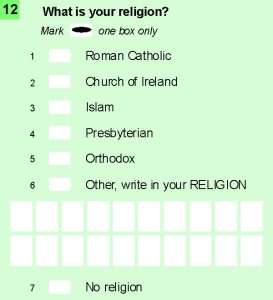
Here is the 12th question for each person in the Census 2016 form: –

Census IRL 2016 Q12 Religion

Census IRL 2016 Q12 Religion

The Central Statistics Office’s computer reads the marks in the boxes, and calculates the numbers in categories 1, 2, 3, 4, 5, and 7. The total of people who marked no 7 will be the CSO number of people with no religion. The more people who do not have a religion who mark box 7, the more the State must recognise that their numbers are substantial.

The religions (or non-religious titles) that people write in the 20 spaces under no 6 will be read by people in the CSO. From these the CSO will derive numbers of people with religions other than the five in the list on the form.
“Atheist”, “Humanist”, “Agnostic”, “No Religion”, and various other words that actually do not mean a religion will result in Census numbers for those titles, as if they are religions. The CSO presents them within a list of other religions (of which there are usually many hundreds). These numbers, which in the 2011 Census were in the tens of thousands, do not enter the public information as numbers of people with no religion.

So, the Mid-West Humanists suggest that people with no religion mark box 7 “No religion”; and do not write in the spaces under box 6.

The Mid-West Humanists also note that (as the CSO instructs enumerators) Question 12 on religion is about your religious belief, actions, or attachment NOW, not at any earlier time in life.
We ask people who are aware of their past attachment to a religion, but who now do not believe in that religion’s doctrines and/or do not attend that religion’s services, to mark box 7 to indicate that they do not have a religion in 2016.

There is a bias in a question if the “none of the above” option is last. The Census 2016 form has 4 household questions and 4 questions for each individual person that include a “none” option.
See The Census should have the None option as the first option